In 1931, Mahatma Gandhi spent twelve weeks living among working-class Londoners while attending the Second Round Table Conference. His daily walks through Stratford and Plaistow offered East End residents a remarkable encounter with one of history's most influential figures.
A Humble Residence in East London
When Gandhi arrived in London in September 1931 as the sole representative of the Indian National Congress, he declined invitations to stay in prestigious hotels. Instead, he accepted an offer from Muriel Lester, co-founder of Kingsley Hall in Bromley-by-Bow, to live at the community centre she had established with her sister Doris. Muriel Lester had previously stayed at Gandhi's ashram in India, and their friendship formed the basis of this unusual arrangement.
Gandhi occupied a small cell-bedroom on the roof of Kingsley Hall, sleeping on the roof itself when weather permitted. He was joined by his secretary Mahadev Desai, his son Devdas Gandhi, and British supporter Mirabehn. The accommodation reflected his commitment to simple living even while engaged in complex diplomatic negotiations about the future governance of India.
Daily Walks Through Newham
Gandhi's connection to Newham emerged through his morning routine. His daily walks began before dawn and typically lasted approximately one hour at a brisk pace. These excursions covered substantial portions of the local area, with one route holding particular significance.
"His daily walk would start before dawn and typically take about an hour at a brisk pace, taking in much of the local area," according to historical accounts from Kingsley Hall. "He particularly enjoyed the walk along the Sewerbank (now known as the Greenway) through Stratford to Plaistow, because of the elevated views it gave."
The Greenway, following the route of Joseph Bazalgette's Northern Outfall Sewer, remains a walking route through Newham today. In 1931, this elevated path offered Gandhi panoramic views across East London. On these walks, he was regularly joined by crowds of well-wishers eager to speak with him. Historical records indicate he occasionally visited the homes of local people during these excursions.
Visitors to Kingsley Hall
Gandhi's residence at Kingsley Hall attracted an extraordinary range of visitors. Charlie Chaplin, the celebrated film actor, made the journey to Bromley-by-Bow to meet him. George Bernard Shaw, the playwright and political activist, also visited. The Pearly King and Queen of east London called upon him, representing local working-class traditions. Former Prime Minister David Lloyd George and Cosmo Gordon Lang, the Archbishop of Canterbury, were among the distinguished figures who sought audiences.
On 3 December 1931, shortly before his departure, Gandhi planted a tree outside Kingsley Hall. The original tree was destroyed during the Second World War and was replanted by Lady Attenborough in 1984.
Historical Context
Gandhi's 1931 visit occurred during a pivotal period in Anglo-Indian relations. The Second Round Table Conference, held between September and December 1931, brought together British officials and Indian representatives to discuss constitutional reform. Gandhi attended following the Gandhi-Irwin Pact, which had secured his release from imprisonment and suspended the civil disobedience campaign.
His choice to stay in a working-class community centre rather than official accommodation carried symbolic weight. It demonstrated his solidarity with ordinary people and his rejection of colonial privilege.
Legacy and Remembrance
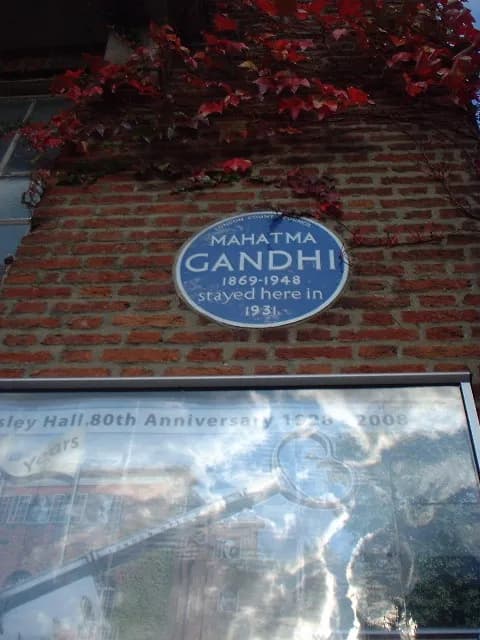
In 1954, the London County Council erected a blue plaque on Kingsley Hall commemorating Gandhi's stay. The room where he slept has been preserved and Kingsley Hall now houses the Gandhi Foundation, continuing the connection between the Lester family's work and Gandhi's principles.
Muriel Lester maintained her association with Gandhi beyond his 1931 visit. She accompanied him on his tour of earthquake-affected regions in Bihar during his anti-untouchability campaign in 1934.
For Newham residents today, the Greenway offers a tangible link to this historical episode. Walkers following the elevated path from Stratford to Plaistow traverse the same route that Gandhi took during his twelve weeks in London.