Tucked away on the River Lea in Newham lies a site where industry has thrived for over a millennium. Three Mills, one of London's oldest surviving industrial centres, has powered everything from Domesday-era grain production to 21st-century film production.
From Domesday to Gunpowder
The earliest recorded mills at this site appear in the Domesday Book of 1086, which documented eight or nine mills on the River Lea at Stratford. This makes Three Mills the earliest recorded tidal mill system in Britain. By the time of the Norman Conquest, these mills were already well established.
Stratford Langthorne Abbey, founded in 1135, acquired the mills during the 12th or 13th centuries. By the time Henry VIII dissolved the abbey in the 1530s, they were grinding flour for the bakers of Stratford-atte-Bow, whose bread supplied the City of London market.
The site's industrial versatility was evident even in Tudor times. In 1588, during the Spanish Armada, one of the mills operated as a gunpowder mill contributing to England's war effort. Gunpowder manufacture is also recorded at the site in 1597 and 1615.
The Age of Distilling
The 17th century saw the mills turn to grain distilling. Around 1730, Peter Lefebure began producing gin at Three Mills, marking the start of a long association with London's alcohol trade. In 1872, the site was purchased by gin distillers J&W Nicholson & Co of Clerkenwell, who produced their Lamplighter Gin there and eventually moved all production to the Newham site.
Distilling continued until 1941, when wartime rationing brought production to a halt. The Nicholson family, headed by Sir Richard Nicholson, subsequently sold the business to the Distillers Company. The brand was revived in 2017, when J&W Nicholson re-launched Nicholson Gin, originally launched in 1736.
Engineering Marvel
The House Mill, built in 1776 by Daniel Bisson, stands as a remarkable feat of industrial engineering. The initials "DSB" on its façade likely stand for Daniel and Sarah Bisson. When fire damaged the mill in 1802, it was quickly rebuilt by Philip Metcalfe, who also rebuilt the Clock Mill between 1815 and 1817.
The House Mill is Grade I listed, one of only four Grade I listed buildings in the London Borough of Newham. It is cited as the largest tidal mill in the world, or at minimum the largest surviving tidal mill in Britain. Its foundations date to between 1380 and 1420, though the current structure is predominantly 18th century.
Records from 1878 reveal the scale of operations. Seven waterwheels, most around 20 feet in diameter, drove fourteen pairs of millstones producing 150 horsepower. The House Mill alone averaged about two tons of maize and five tons of barley per tide, rising to ten and fourteen tons respectively on spring tides. The two mills together processed 125 tons weekly.
War, Decline and Rescue
Three Mills sustained severe air-raid damage during the Second World War. The Miller's House was destroyed on 15 October 1940 by a bomb that landed on a nearby bonded warehouse. The House Mill ceased operation that same year; the Clock Mill continued until 1952.
In the post-war period, the site was used for bottling and warehousing by Bass Charrington and Hedges & Butler, who bottled Bacardi there. By the 1970s, the House Mill faced demolition, as site owners Hedges & Butler wanted a car park. It was saved by the Passmore Edwards Museum Trust, later renamed the River Lea Tidal Mill Trust Ltd, now the House Mill Trust.
The Miller's House was demolished in the late 1950s, then reconstructed in the 1990s with European Union funding. The façade was rebuilt to the original 1763 design using recovered bricks, winning a Civic Trust Commendation in 1996.
Three Mills Today
Today, Three Mills Island lies in Bromley-by-Bow within the London Borough of Newham, forming part of the 50-mile Lea Valley Walk. The Prescott Channel, a former flood relief channel, passes to the east, creating an island.
The House Mill, owned by the River Lea Tidal Mill Trust Ltd (Registered Charity No 292336), opens to visitors on Sunday afternoons during the summer. Tours run at 11:30am, 1:30pm and 3:00pm, costing £10 per person, including a guidebook and hot drink. The water wheels are currently not in operation, though the Three Mills Wall River Weir stabilises water levels at 7.5 feet, which may allow future operation.
The site shares the island with 3 Mills Studios, a 10-acre film and television facility with 75,000 square feet of sound stages. The studios have hosted major productions including Legend, Eastern Promises, Fantastic Mr Fox, The Great, Third Day and Stranger Things: The First Shadow. They served as the home of Danny Boyle's team for the 2012 Olympic ceremonies.
The House Mill Trust runs educational projects, heritage tours, concerts, art exhibitions, weddings and community events. The Miller's House provides a visitor centre, education rooms, meeting spaces and the Miller's House Café.
Olympic Legacy and Regeneration
The 2012 Summer Olympics brought significant infrastructure changes to the area. The Three Mills Lock on the Prescott Channel was constructed between 2008 and 2009 by British Waterways and officially opened on 5 June 2009. Measuring 62 metres long and 8 metres wide, it can hold two 350-tonne barges, allowing freight access to the Olympic site.
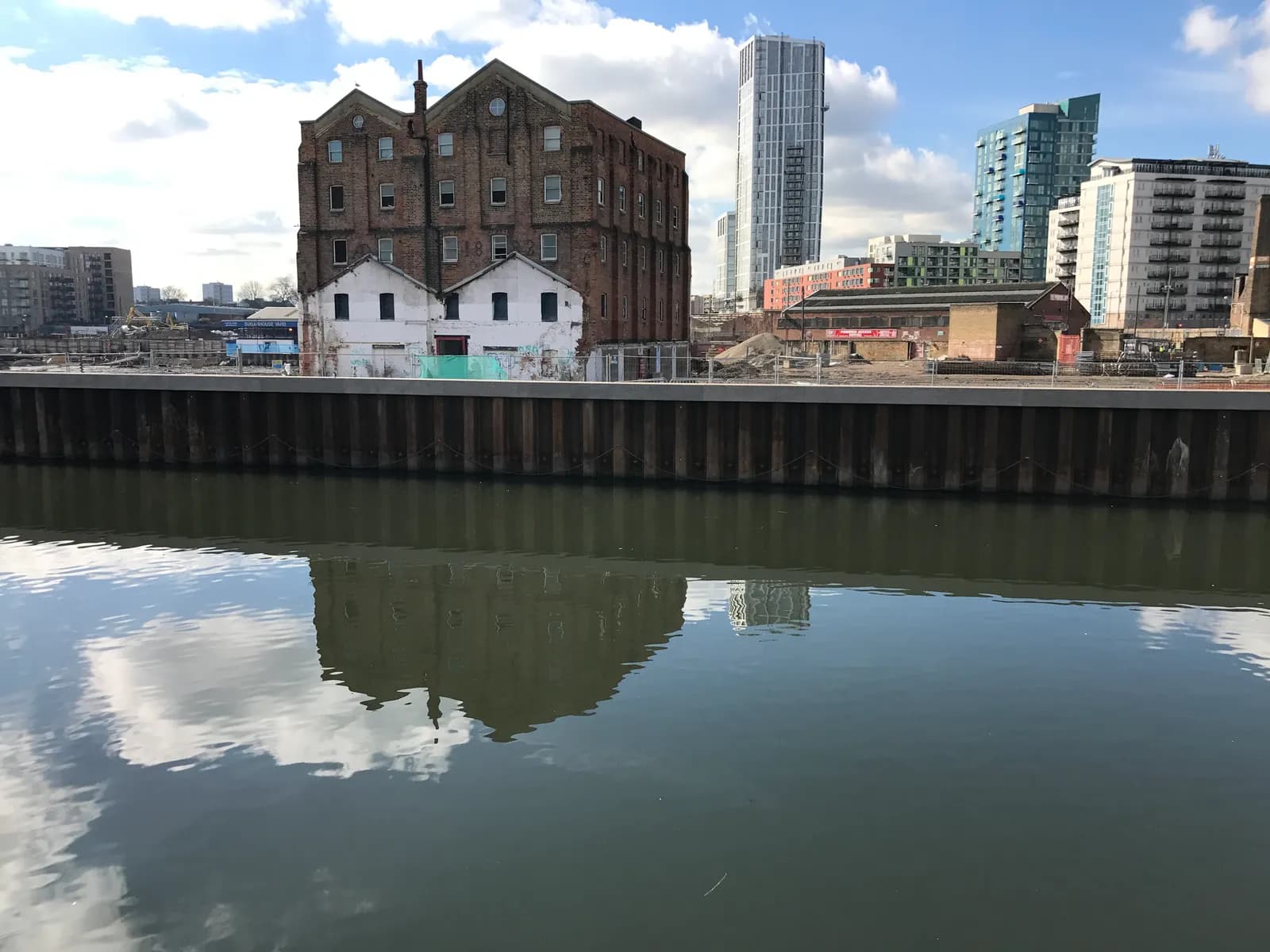
Opposite the mills, the 26-acre area historically known as the Three Mills District is now Sugar House Island. Developed by Vastint, it is expected to bring 2,500 jobs, 624,000 square feet of office space and 1,200 new homes. A former sugar warehouse is being refurbished to become a heritage asset within the development.
Three Mills Green, an open green and play area, also occupies the island, providing recreational space amid the industrial heritage.
Newham's Hidden Treasure
Despite lying within Newham and being one of the borough's most significant historical assets, Three Mills remains surprisingly unknown to many residents. Its location in Mill Meads, with access principally from the Tower Hamlets side of the River Lea, has perhaps contributed to its low profile.
Yet this site encapsulates Newham's industrial spirit across a thousand years. From grinding grain for Norman lords to distilling gin for Victorian Londoners, from surviving the Blitz to hosting Hollywood productions, Three Mills stands as testament to the borough's remarkable capacity for reinvention. For those seeking to understand Newham's past and present, the island's mills offer an unmatched journey through time.