Between 1855 and 1921, three vast docks rose from the marshland of Plaistow in Newham to form the largest enclosed harbour ever constructed. The Royal Docks transformed the area into the beating heart of global maritime trade, employing generations of local families and shaping the communities of Canning Town, Silvertown, and Custom House.
Victoria Dock: Engineering Firsts on the Marshes
The first of the trio, Victoria Dock, opened in 1855 after five years of construction on previously uninhabited Plaistow Marshes. Engineer George Parker Bidder designed a facility that broke new ground in dock technology. It was the first London dock built specifically for large steam ships, the first to use hydraulic power for operating machinery, and the first connected directly to the national railway network via the Eastern Counties and Thames Junction Railway, now part of the North London Line.
The dock featured 3.6 kilometres of quays and four solid piers, each measuring 152 metres by 43 metres, complete with two-storey warehouses. By 1860, just five years after opening, it was handling over 850,000 tons of shipping annually. This volume was double that of London Docks, four times that of St Katharine Docks, and 70 per cent more than the West and East India Docks combined. The "Royal" prefix was granted in 1880.
Royal Albert Dock: Expanding the Empire
The success of Victoria Dock prompted an extension. Sir Alexander Rendel designed the Royal Albert Dock, completed in 1880 by contractors Lucas and Aird. This addition pushed the complex's capabilities further, allowing even larger vessels to berth and establishing Newham as the principal gateway for food imports into London.
The docks specialised in grain, tobacco, meat, fruit, and vegetables, with giant granaries and refrigerated warehouses lining the quays. The produce arrived from across the British Empire and beyond, requiring a vast workforce of dockers, warehousemen, carters, and packaging workers.
King George V Dock: The Final Piece
The Port of London Authority began work on the third dock in 1912, though the First World War delayed completion until 1921. King George V himself officiated at the opening. The new dock covered 64 acres of water and could accommodate liners as large as the RMS Mauretania, which weighed 35,655 tons. Its own entrance from the Thames, complete with a lock and bascule bridge, allowed ships to enter independently of the other docks.
When complete, the three docks together comprised nearly 250 acres of water within an overall estate of 1,100 acres. Their collective quayside stretched more than 12 miles, capable of serving hundreds of cargo and passenger ships simultaneously. This was, and remains, the world's largest enclosed harbour.
The Communities That Built the Docks
The docks drew workers from across London and beyond, creating the multicultural communities that define Newham today. Canning Town, north of the Royal Victoria Dock, expanded rapidly after 1846 when the North London Line arrived. Named after Charles John Canning, Viceroy of India, the area was described in 1857 by journalist Henry Morley as a slum lacking drainage, paving, gas, or proper water supply.
Custom House took its name from the customs house serving Royal Victoria Dock. The population of West Ham, which contained the docks, reached 289,030 by 1911, making it the seventh-largest county borough in England. Silvertown, south of the docks, grew around S.W. Silver and Company, established in 1852, and later became home to the Tate and Lyle sugar refineries and the Brunner Mond munitions factory.
War, Crisis, and Resilience
The docks played a vital role during the Second World War. Despite suffering severe damage during the Blitz, with an estimated 25,000 tons of ordnance falling on docklands, they remained operational throughout the conflict. In 1944, the Mulberry harbours used during the Normandy landings were constructed in secret within the Royal Docks before being towed to Folkestone.
Earlier, during the General Strike of 1926, the docks faced a different crisis. When electricity was cut off, 750,000 frozen carcasses were threatened with spoilage. The Royal Navy connected two submarine generators to power the warehouse freezers, saving the meat and preventing catastrophe.
Not all disasters were averted. On 19 January 1917, 50 tons of TNT exploded at the Brunner Mond factory in Silvertown. The blast killed 73 people and damaged 70,000 buildings, marking the largest explosion in London's history.
Decline and Closure
From the 1960s, containerisation began to render the Royal Docks obsolete. New cargo vessels grew too large for the docks' locks and basins, and traffic moved downstream to Tilbury. The docks survived longer than any other upstream facilities, but commercial traffic finally ceased in 1981. The last vessel was loaded on 7 December that year.
The closure devastated local employment. North Woolwich and Silvertown, heavily dependent on dock work, experienced massive unemployment and social deprivation.
Regeneration and the Future
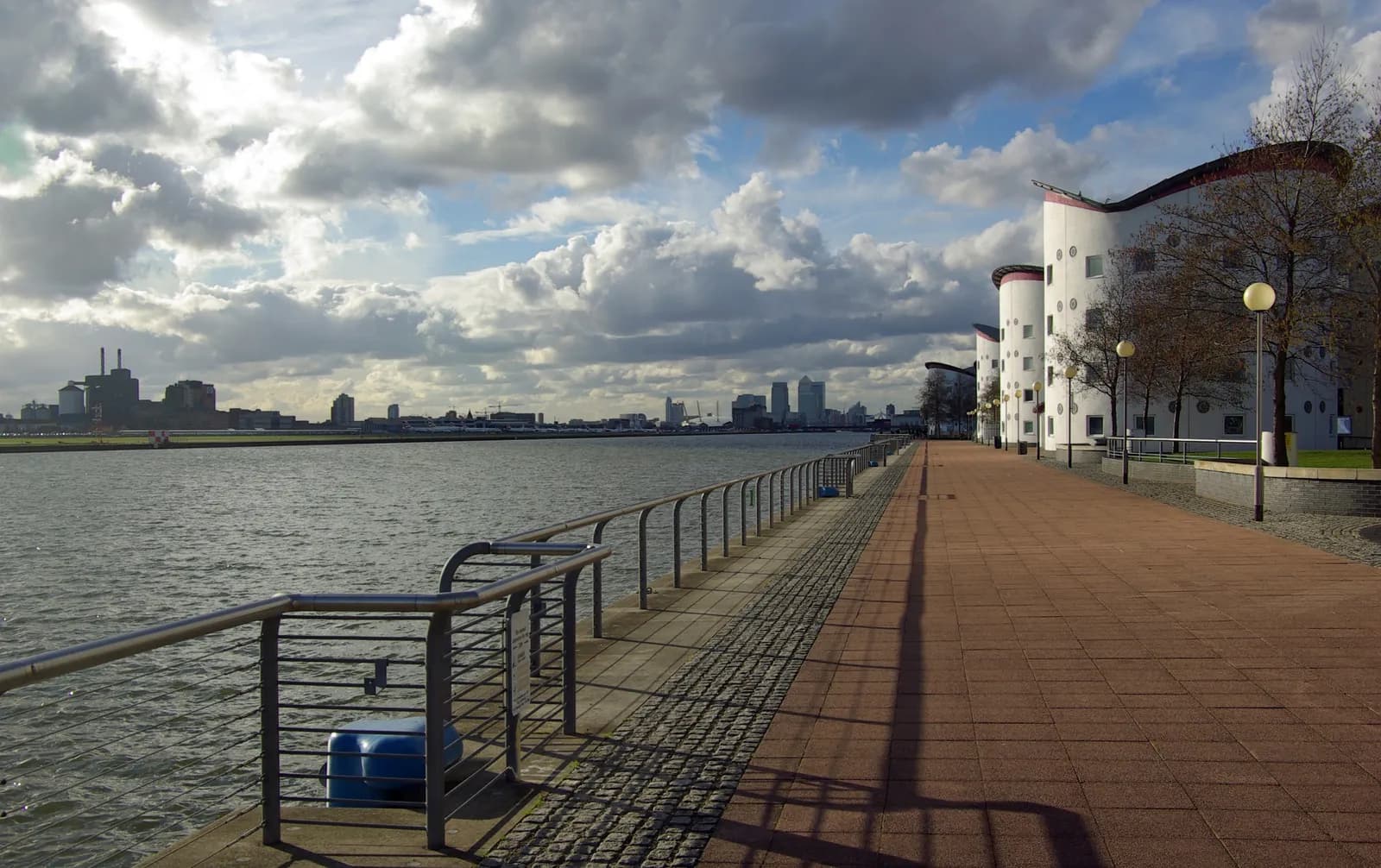
The London Docklands Development Corporation was formed in 1981 to regenerate the area. London City Airport opened in 1988 on the quay between Royal Albert Dock and King George V Dock. The Docklands Light Railway arrived in 1994, later extending to serve the airport in 2005. The ExCeL Exhibition Centre opened on the north quayside of Royal Victoria Dock in November 2000, and the University of East London established its Docklands Campus on the north bank of Royal Albert Dock in 1999.
Recent developments include the Elizabeth Line, which began serving Custom House station in 2022, and the ongoing Silvertown Quays redevelopment, approved in 2015 at a projected cost of £3.5 billion. The Royal Wharf development has added 3,385 new homes housing over 10,000 people.
The docks themselves remain largely intact, now serving recreational uses such as open water swimming, rowing, and water sports. What began as Victorian engineering ambition has evolved into a 21st-century waterfront district, testament to Newham's capacity for reinvention.