A Derelict Theatre Reborn
In 1953, a small theatre company arrived in Stratford, Newham, and transformed a derelict Victorian playhouse into one of the most influential theatres in British history. Joan Littlewood, together with her Theatre Workshop company, took the lease on the Theatre Royal Stratford East and staged their first production, Twelfth Night, on 2 February 1953.
The building, which opened on 17 December 1884 with a production of Richelieu, had fallen into disrepair. Designed by architect James George Buckle, it was his only surviving work and holds Grade II* listed status. When Littlewood's company arrived, they found a theatre closed and decaying. The company cleaned, painted, and slept in the building between rehearsals, living as a commune with shared tasks including a "chef of the week" roster.
The Mother of Modern Theatre
Joan Maud Littlewood was born on 6 October 1914 in Stockwell, south London. She trained at RADA but left after an unhappy start. In 1934, she married folk singer Ewan MacColl, though the couple divorced in 1950. Her life partner thereafter was Gerry Raffles, who became manager of Theatre Workshop and in whose name the square outside the theatre is now known: Gerry Raffles Square, London E15 1BN.
Littlewood earned the title "The Mother of Modern Theatre" through her revolutionary approach to performance. She incorporated Rudolf Laban's dance theories and embraced the English music hall tradition. Her methods demolished what theatre critic Michael Billington later described as "the barriers we erect between 'popular' and 'art' theatre."
Breaking the Rules
Littlewood's approach was unorthodox and occasionally brought her into conflict with authorities. She was prosecuted and fined twice under the Theatres Act 1843 for allowing improvisation in performance. MI5 maintained surveillance on her from 1939 through the 1950s, and she was banned from BBC broadcasting between 1941 and 1943 due to communist associations.
Her company developed plays through improvisation. Cast members would learn scripts, then retell the stories in their own words. This technique produced raw, authentic theatre that gave voice to working-class experiences previously absent from British stages.
Productions That Changed Theatre
In May 1958, Theatre Royal Stratford East premiered A Taste of Honey by 19-year-old Shelagh Delaney. The play, starring Frances Cuka as Jo, Avis Bunnage as Helen, and Murray Melvin as Geoffrey, addressed class, race, gender, sexual orientation, and illegitimacy. It transferred to Wyndham's Theatre in the West End on 10 February 1959, and the 1961 film adaptation won four BAFTAs. The production helped establish the "kitchen sink" genre that revolutionised British theatre.
October 1958 saw the premiere of Brendan Behan's The Hostage, developed through improvisational techniques that saw the text revised during production. The following year, Fings Ain't Wot They Used T'Be transferred to the West End, running from 1959 to 1962.
The company's greatest success came with Oh, What a Lovely War!, which premiered on 19 March 1963. The idea came from Gerry Raffles, who heard Charles Chilton's radio musical The Long Long Trail on Armistice Day 1962. The cast researched First World War topics including Ypres and gas warfare. Littlewood dressed them in pierrot costumes and metal helmets, refusing military uniforms, and projected slides with war statistics onto screens. The production won the Grande Prix du Festival at the 1963 Paris International Festival of Theatre and transferred to Wyndham's Theatre in June 1963, then to Broadway in 1964, where Victor Spinetti won a Tony Award for Best Featured Actor.
A Lasting Legacy in Newham
Theatre Royal Stratford East survived threats of demolition during 1970s Stratford shopping centre development through a public campaign and its Grade II* listing. Today it continues its mission of championing diversity both on and off stage, a commitment that began under Littlewood's leadership.
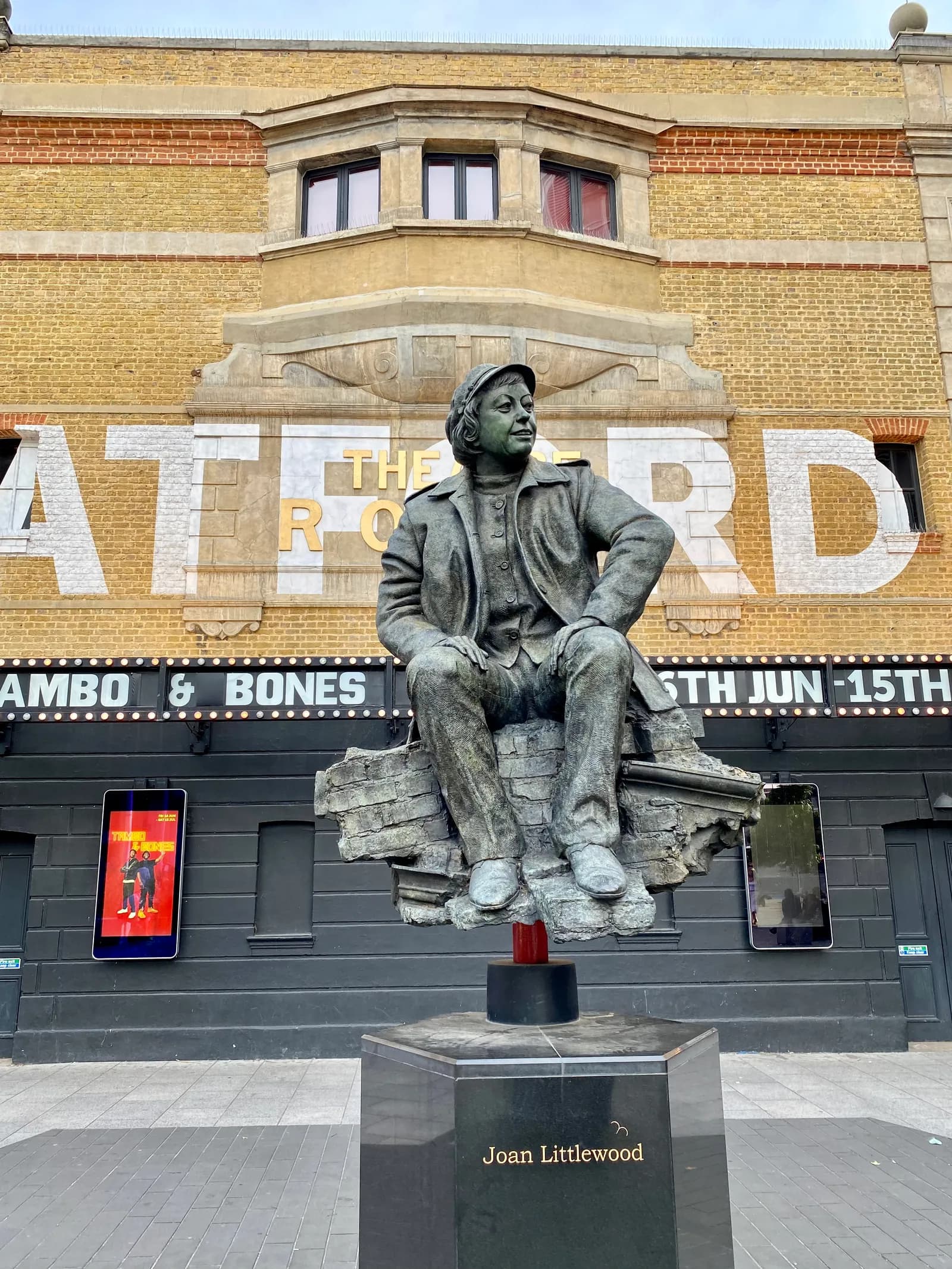
A sculpture of Joan Littlewood by Philip Jackson stands outside the theatre, unveiled on 4 October 2015. A commemorative plaque notes that Littlewood arrived at Theatre Royal Stratford East with her Theatre Workshop Company in 1953 and ran it with her partner Gerry Raffles until 1974.
Following Raffles' death in 1975, Littlewood moved to France and ceased directing. She died in London on 20 September 2002, aged 87. She was awarded the Society of London Theatre Special Award in 1983 and made Commandeur de l'ordre des Arts et des Lettres in 1986.
The Theatre Today
Theatre Royal Stratford East continues to serve Newham's diverse community, which comprises 69.2 per cent ethnic minority residents according to 2021 census data. The theatre runs community programmes including Newham Neighbours, youth initiatives, Future Leaders, Stratford East Singers, and Pay What You Can performances.
Successive artistic directors have maintained Littlewood's ethos. Philip Hedley led the theatre from 1979 to 2004, continuing educational work with Asian and Black audiences. Kerry Michael served from 2004 to 2017, focusing on new communities. Nadia Fall directed from 2017 to 2025, and Lisa Spirling took over in 2025.
The theatre's 2023 "Black Out" nights for the production Tambo & Bones, dedicated performances for Black audiences, sparked national debate. Artistic Director Nadia Fall defended the initiative as addressing historical white-centrism in theatre, continuing the venue's tradition of challenging conventions.
Architectural Heritage
The Theatre Royal Stratford East retains its Victorian character with 460 seats on three levels. The proscenium still bears the letters "FF", representing the Frederick Fredericks family who once owned the theatre. Following a fire on August Bank Holiday 1921, the auditorium was saved by the safety curtain, and the theatre reopened in January 1922. Significant renovations occurred in 1902 by Frank Matcham, again in 1984, and in 2001 with Heritage Lottery Fund support.
The theatre benefited from the 2012 Olympic Games cultural quarter regeneration, which transformed Stratford and the surrounding area. Its current slogan, "Stratford East. Here for Great Theatre," reflects both its heritage and its ongoing commitment to the community Joan Littlewood first embraced in 1953.